Historical facts
Rhede, originally a peasantry with scattered single farms, belonged to the original parish of Bocholt. The oldest known name for Rhede is "Rethi" and appears for the first time around 1050 in the registry of the Monastery on the Ruhr, which ruled at that time over numerous properties also in our area. The name "Rethi" (and later in 1150, "Rethe") probably stems from the word "rêt"=Riet, reed, because the reed found favorable growth conditions in the marshlands formed by the Rheder Brook.
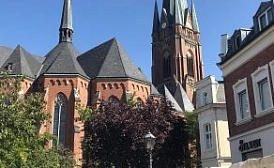
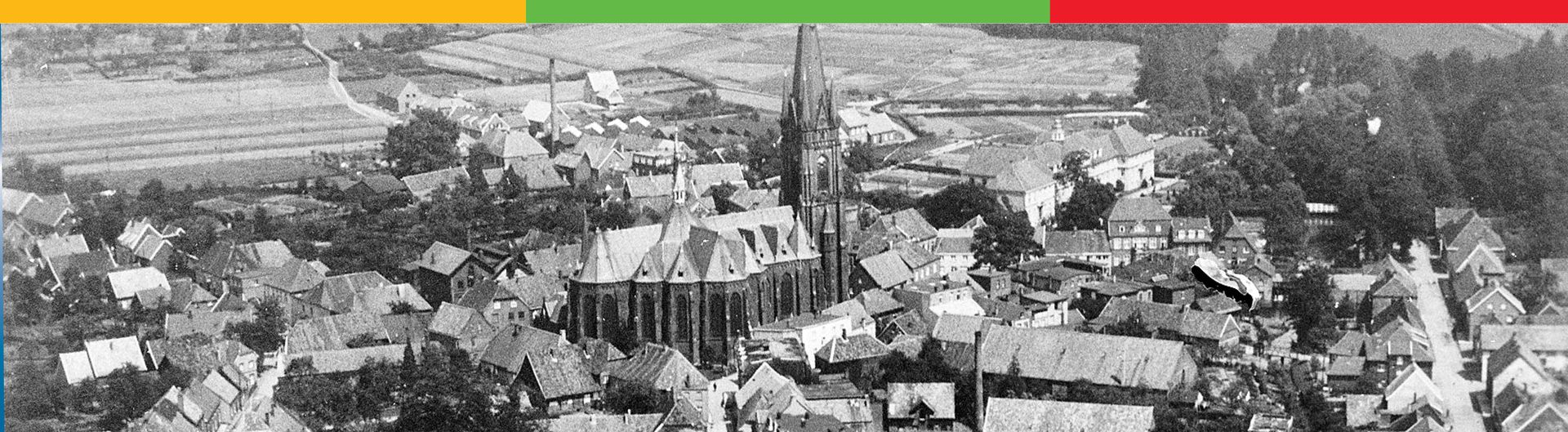
The name of a knight from Rethe, belonging to the House of Rhede, is mentioned for the first time in the middle of the 13. century. The founders of the House of Rhede were most certainly also the founders of the parish church. Gradually a village settlement formed around the holy Gudula Parish Church, which has been called Rhede since 1300.

- seal Werner von Rhede 1304

- seal Adrian von Rhede 1500
In the middle of the 13. Century, the ruling men of Rhede built a castle located east of the church at the place designated as "burg" (castle). It was probably destroyed in 1324 by the bishop of Muenster and today know as the Gudulakloster/Klausenhof. Around 1370 the possession of the old castle seat changed hands to the House of Rhemen, and was renewed as the castle "on the mountain". In 1388 it was again destroyed, permitting the Bishop of Muenster a reconstruction in 1426 of the castle "Bergfried und Beihaus bei dem Dorfe." House Rhede was located on the property of today's Castle grounds. In 1564, Lubbert von Rhemen replaced the castle with a stately manor-house, whose northeast wing and tower exists still today.
Up until 1695, House Rhede changed hands several times: von Coevorden, von Kleist, von Wartensleben, until finally the royal family of Salm Salm acquired House Rhede in 1850. The castle still belongs to the family today.
In the course of history, the municipality of Rhede has repeatedly experienced times of trouble, which were caused by wars, epidemics and harvest failures. Rhede was especially affected at the end of the 16. century by the Spanish-Dutch War (1566-1609). The Thirty Year War (1618-1648) brought the ill-fated occupation of Rhede by hessian troops for many decades. During the Muensterland-Dutch War, our area was strongly affected by the martial policy of Prince Bishop Bernhard von Galen. Starting in 1674, decades of peace followed, which were only interrupted by the Seven Year War (1756-1763).
The Royal Termination Delegation of 1803, brought the political downfall of the Royal Principality of Münster, to which Rhede had belonged for over more than 600 years. In the following years the political affiliation of the municipality changed several times. From 1803 to 1810 Rhede and its 3700 inhabitants belonged to the Principality of Salm Salm, and were merged in 1810 with the French Empire and finally fell in 1815 to Prussia. The administration of Rhede was then formed in 1841.
In the following decades Rhede showed only little development. The number of inhabitants stagnated. The agriculture was little productive and offered only small possibilities of existence. The population predominantly lived from flax spinning and weaving. Then around 1890 a new chapter in Rhede history began. The first textile factories were created, and within a few decades they grew from small businesses to large enterprises. Parallel to economic progress, common forms of development also persisted. The townscape changed, new roads were laid and alleys built to the surrounding farms. The completion and inauguration of the new parish church took place in 1901, and in 1902 the connection to the local railway line, Muenster-Empel, was established. A municipality gas works was built in 1906, which supplied the houses and roads of Rhede with light. Since then the positive development of the municipality has persisted.
The two world wars slowed growth in Rhede, but were not able to stop it. Particularly after 1945 rapid advancement began, giving Rhede the character of an industrial town. Handicraft and trade prospered harmoniously side by side. The agricultural properties also developed into modern, proficient enterprises.
In the local sector, numerous projects were completed, i.e. the creation of the central water supply, the laying of sewerage systems and building of the sewage purification plant, road construction, the construction of a modern, outdoor swimming pool, the establishment of the school center and other school buildings, as well as the reconstruction of the Rhede city center.
In the course of the local reorganisation in 1968, Buengern, Krechting, Krommert, Rhede and Vardingholt united to form a new municipality all under the name Rhede; the towns Rhede and Altrhede already having been united in 1955.
Particularly in the years after 1968, the city planning developed in an urban direction. The number of inhabitants of the 78.6 square kilometers municipality increased from 13,200 to over 19.000 and rises still continuously today. About 13,200 inhabitants live within the city limits of Rhede. The town preserves it´s urban influence from new and modernized businesses, banks and restaurants, the creation of green belts and lighting systems, from recreation and sport facilities, as well as from progressive housing development.
Thus the existence of the city Rhede and its borders has remained untouched by the general regional reorganization as of January 1, 1975 in Muensterland and in the neighbouring Niederrhein district - proof of efficiency and self-sufficiency and an indication of it´s central importance.
As of 25.7.1975, Rhede was designated a "city" by the ministry of the Interior of the state of North Rhine-Westphalia.
In the spring of 1981, a federal and national athletic center was built in Rhede, equipped with the most modern technology, located on the B 67 highway.
In August 1994 the new city hall and city center project was officially opened, after a less than two-year construction period, with a large city celebration for the entire population.